
Aquarium Water Parameters Explained
TankAndFin is reader-supported. If you buy through our links we may earn a commission at no extra cost to you. As an Amazon Associate we earn from qualifying purchases. Disclosure.
Here's each number on your test kit, what it means and the range to aim for, from University of Florida fact sheets and Aqueon.
The parameters
| Parameter | Target | Why it matters |
|---|---|---|
| Ammonia | Zero (UF, Aqueon) | UF: un-ionized ammonia above 0.05 mg/L can damage fish tissue |
| Nitrite | Zero (Aqueon) | UF: toxic "as low as 0.10 mg/L" |
| Nitrate | Under 50 ppm (Aqueon) | UF: newer research suggests it may be more harmful than once thought |
| pH | 6.8-7.8 for most tropicals (Aqueon) | Higher pH shifts ammonia to its more toxic form (UF) |
| GH (general hardness) | Most fish adapt to local water (Aqueon) | Calcium, magnesium and other ions |
| KH (carbonate hardness) | UF: nitrifying bacteria struggle below 20 mg/L alkalinity | Buffers pH against swings |
Ammonia: the big one
UF explains that test kits usually measure total ammonia nitrogen, and that un-ionized ammonia "is approximately 100 times more toxic to fish than the ionized" form. "The portion of un-ionized ammonia increases with increasing pH and/or temperature." So the same test reading is more dangerous in a warm, alkaline tank.
Nitrite
Aqueon: "The only safe nitrite level is zero," and with nitrite poisoning, "gill filaments will turn from bright red to dull brown." API says a partial water change removes nitrite.
Nitrate
UF says nitrate was long considered harmless up to 200 mg/L, but "more recent research is showing nitrate may be more detrimental than previously believed." Aqueon calls levels above 50 ppm "undesirable" and suggests testing your tap water, since some is high in nitrate.
pH, GH and KH
Aqueon says pH "tends to drop over time" as organic material breaks down, and advises: "do not try to manipulate the pH or hardness level in your aquarium with additives." UF's general freshwater ranges: pH 6.5 to 9.5, total alkalinity 50 to 250 ppm and total hardness above 20 ppm, while noting tolerance is species dependent.
Using reverse osmosis (RO) water? RO strips out most minerals, so it doesn't bring GH or KH with it. Seachem describes its Equilibrium as suited to RO, deionized or other mineral-deficient water to restore GH, and for KH it recommends its separate Alkaline Buffer. If you're considering an RO unit for the tank, our sister site PureFlow Lab explains what RO water is and what it removes.
Temperature
Aqueon: most tropicals 75 to 80°F, bettas 76 to 85°F, goldfish 68 to 74°F. UF warns sudden temperature changes can cause temperature shock. See heaters.
Testing
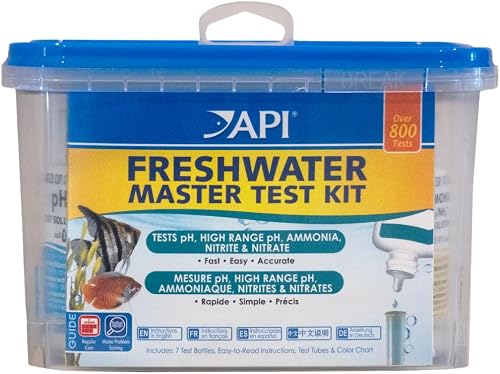
API Freshwater Master Test Kit
- Tests pH, high-range pH, ammonia, nitrite and nitrate, per the listing
- 7 test solutions, color card and 4 tubes
- Listed as 800 tests; freshwater only
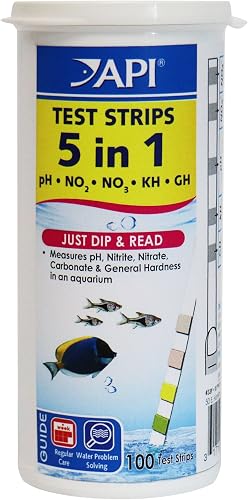
API 5-in-1 Test Strips (100 count)
- pH, nitrite, nitrate, carbonate (KH) and general hardness (GH), per the listing
- Dip and compare colors
- Fresh or saltwater; no ammonia pad
More in aquarium test kits.
FAQ
Safe ammonia?
Zero.
pH?
6.8-7.8 for most tropicals, per Aqueon.
GH and KH?
General and carbonate hardness.