
Aquarium Water Conditioners: Why Tap Water Needs One
TankAndFin is reader-supported. If you buy through our links we may earn a commission at no extra cost to you. As an Amazon Associate we earn from qualifying purchases. Disclosure.
Every water change needs treated water. Here's why, per the EPA and University of Florida, and how Prime and Stress Coat differ. Product details are from Seachem, API and the listings; we haven't tested them.
Why tap water needs treating
The EPA: "Chlorine and monochloramine can be harmful to fish because they directly enter their bloodstream through the gills," and they "can also prevent the growth of beneficial bacteria." The good news, also from the EPA: treated water "can be safely used in aquariums by using products readily available from aquarium supply stores."
Chlorine vs chloramine
UF: "Chloramine is a combination of chlorine and ammonia. Sodium thiosulfate and aeration does NOT remove chloramines. A commercial product must be used." Seachem puts it simply: "chloramine minus chlorine = ammonia." That leftover ammonia is why some conditioners also bind it. Your water utility can tell you which it uses.
Conditioners compared
| Seachem Prime | API Stress Coat | |
|---|---|---|
| Removes chlorine and chloramine | Yes | Yes |
| Detoxifies ammonia | Yes (Seachem) | Not claimed |
| Other | Detoxifies nitrite and nitrate (Seachem) | Aloe vera for slime coat; detoxifies heavy metals (API) |
| Dose | 5 mL per 50 US gal of new water | 5 mL per 10 gal |
Full comparison: Seachem Prime vs API Stress Coat.
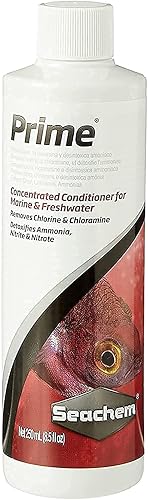
Seachem Prime (250 mL)
- Removes chlorine and chloramine, per the listing
- Detoxifies ammonia and nitrite at typical tap-water levels
- 5 mL treats 50 US gallons of new water
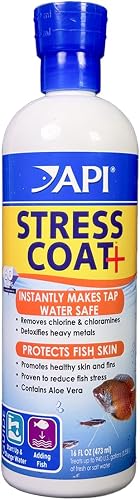
API Stress Coat (16 oz)
- Makes tap water safe, per the listing
- Aloe vera to help replace the slime coat
- 5 mL per 10 gallons; double dose for damaged fins
Using it
- Seachem says to dose for the new water, and that each cap thread is about 1 mL for small volumes.
- If you refill with a faucet changer, Python says to add conditioner during refill. If you add it straight to the tank, dose for the whole tank volume (Seachem and API dose by water volume).
- Seachem says Prime "may be used during tank cycling" and "will not halt your cycling process." See cycling.
FAQ
Need a conditioner?
Yes for chlorinated or chloraminated water, per the EPA.
What's chloramine?
Chlorine plus ammonia, per UF.
Let water sit out?
Doesn't remove chloramine.